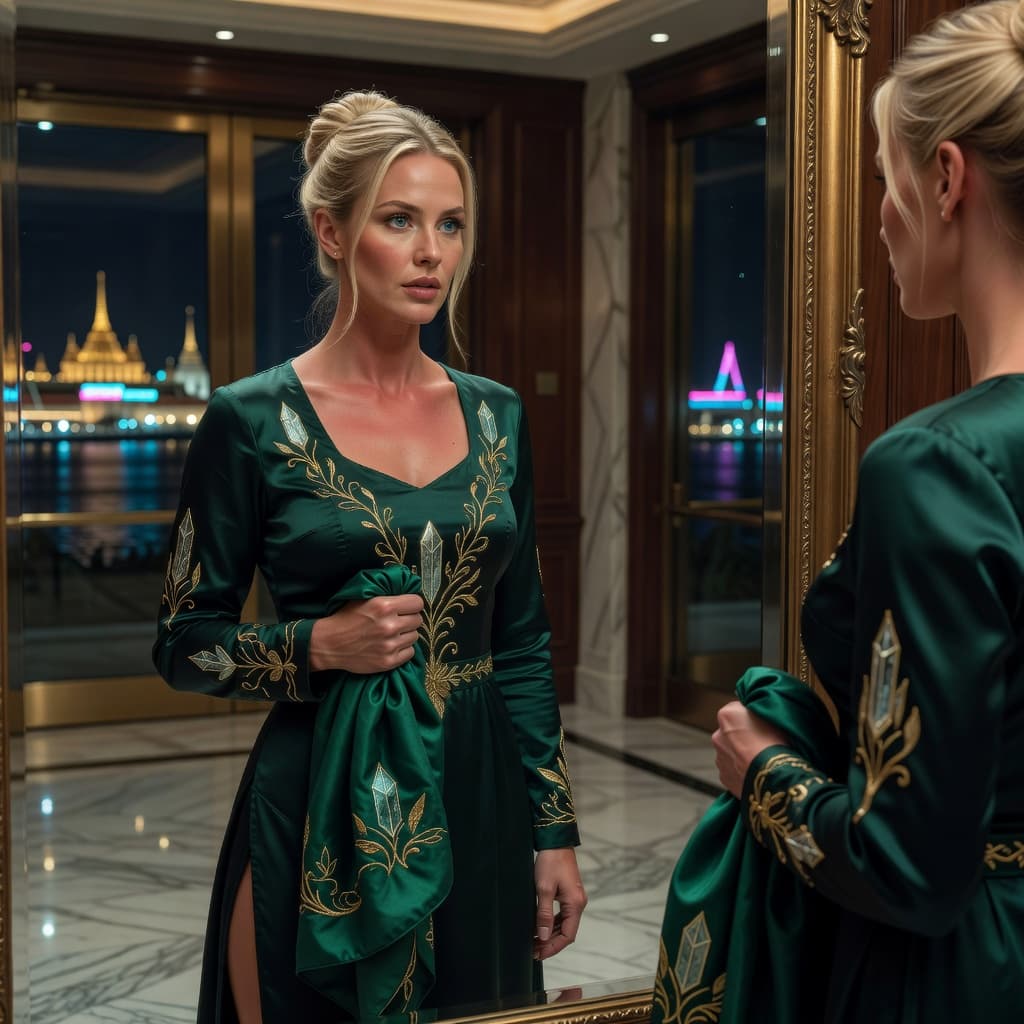
The lamp in the nursery had been turned down to a coin of light. Dara slept on his side, mouth open, one fist caught in the sheet the way he had slept since he was small enough to hold in both her arms. Suvan sat on the edge of the bed in the under-robe she would not be seen in, and laid her palm on his forehead.
Heat. Not the heat of a room. The heat of a child working at something in his sleep.
“Majesty.” The nurse, already shrinking. “It rose again after the second cloth. I can send for—”
“No.” Her voice came out too sharp. She made it softer, for him, not for the woman. “If it climbs past this, you send for me. Not the physicians first. Me.”
Dara made a sound that was almost a word and turned into her hand. For a few seconds she was only a mother. The silk at her wrist was damp from the cloth. His hair stuck to it. She could have stayed. She could have let the banquet start without her and paid for that absence later, in some other currency.
She smoothed the hair off his temple, left the heat of him on her palm, and went to be dressed in crimson.
The banquet hall was a long rectangle of gold and shadow, built to remind every guest that they were small before the monarchy. A single table ran its length, black teak polished until it held the chandeliers like a still pool. At one end sat the Queen Mother, her back to the gilded wall, crimson silk leaving her shoulders bare and her legs exposed from mid-thigh down.
The silk was traditional, thigh-high, the same cut that the King's grandfather had designed for his consorts. Somewhere in the decades since, it had become formal dress for all women at court. Suvan wore it as armor. She wore it as camouflage. She wore it as the costume of a role she had stopped believing in years ago, but could not afford to stop performing.
Opposite her, the chair at the far end of the table stood empty.
No one had spoken of it. No one needed to. It belonged to the King, who was dying — so the court was told — three corridors away, behind screens and physicians and the muffled theatre of a body failing in private. Suvan had not been summoned to that bedside in weeks. The empty chair was more present than any occupied seat. It divided the guests into those who sat closer to her and those who sat closer to absence.
She had counted thirty-seven. Ministers. Nobles. Officers whose medals clicked the table edge. Merchant princes who had bought proximity. Three seats down from her right hand, Henry Viriya, who had loved her since he was sixteen.
She did not look at Henry. She smiled at the Minister of Fisheries and his season’s catch. She nodded at the proper intervals. Left hand on the table, ruby rings catching the light. Right hand in her lap, hidden by the tablecloth, tracing slow circles on her own thigh. The gesture looked like patience. It was calculation.
She had been performing for forty minutes when the messenger arrived.
Young. Perhaps twenty. Plain white temple robes. Eyes down, the way all servants were trained to move. He stopped at her elbow with a bow so low it was almost a prostration and offered a silver tray. One folded paper. Black wax. The Patriarch’s mark.
“Majesty. A message from His Holiness.”
She took it. She did not open it at once. She thanked him with the smile she had practiced since she was eighteen, the smile that said, I am gracious, I am composed, I am not afraid, and waited until he had retreated, until the Minister had turned to his neighbour, until cutlery and conversation had swallowed the interruption. Then she broke the seal beneath the table and read by feel more than sight.
I see you, Majesty. The Inner Sanctum opens only to those who conceal nothing. Reveal what you would hide from all others, and I shall reveal what no other living soul may witness.
Her hand did not tremble. Her face did not change. She had read worse messages from better men. But something cold settled in her stomach, a familiar weight, the price of admission to every room that mattered in this kingdom.
A wine steward knelt near her chair for a dropped spoon. Too close. Too low. Cool air found the highest part of her exposed thigh, where the crimson had curled back toward the sliver of white lace beneath. Her fingers pinned the silk to her skin. If he lifted his head an inch, he would see what no servant in the kingdom could be allowed to see.
He rose without looking up. Trained well. Terrifyingly well.
Beneath the table, behind the carved teak, ran a passage built two centuries ago so servants could clear plates without disturbing the performance above. Vong had claimed it decades ago, adding stepped platforms at the viewing points, turning service into surveillance.
He was there now. She could not see him. She could not hear him. She felt him. He had been watching the entire banquet. He had sent the note when he was ready for her to know. The timing was the message. I can reach you anywhere. Even here. Even now.
She folded the paper into a tight square, slipped it into the hidden pocket of her robe, and asked the Minister of Fisheries a question about tuna that made him glow.
For ten minutes she performed. A general’s joke about Vannakhai’s navy. A merchant’s wife’s jade. Henry’s hand, briefly, when he leaned in to refill her wine; he shivered at the contact. All the while she ran the geometry of her own body — angles, exposure, the exact moment the room’s attention would fracture enough to allow what the note demanded.
The Minister of Fisheries rose unsteadily to propose a toast. Glasses lifted. Eyes turned.
Her right hand slipped beneath the tablecloth.
The steward was still somewhere down the line, head lowered by discipline rather than mercy. Saliva pooled at the back of her tongue. Suvan swallowed copper and fear.
For Dara. His fever still ghosting her palm. Everything for Dara.
Her fingers found the delicate lace edge of her panties.
The Minister of Fisheries lifted his glass. Thirty-seven people followed. Crystal caught the chandelier light. For one absurd second she thought: no. No crown was worth this. No priest, no mandate, no dying king, no whispering old man beneath the floor had the right to reach under her robe in a room full of her own court.
She saw, instead of the toast, Dara’s lamp. The open mouth. The fist in the sheet. A child who would not survive a court that had no use for him unless she bought the use.
The thought of no collapsed. Her fingers moved again.
She lifted her hips a fraction — a tiny, dangerous shift disguised as adjusting her posture. The white lace slid down. Past her hips. Past the smooth curve of her thighs. It caught at her knees, snagging on her skin, and she had to shift again, another small, perilous movement that made the crimson silk whisper against her skin. The fabric finally slipped free. She rolled it into a tight, damp knot in her palm and felt her own terror against her fingers.
The Minister finished his toast. Glasses clinked. Conversation surged back to life.
The acolyte was at her elbow again. Their hands met beneath the table. For one terrible heartbeat their eyes locked. His widened in naked shock as he understood what she had pressed into his palm: the Queen Mother’s lace, still warm. A flush crawled up his neck. She looked away first, cheeks burning with a shame she refused to let reach her face.
Conversation flowed around her again, but the world had narrowed to the space between her thighs. She sat perfectly still, spine straight, soft diplomatic smile fixed on her lips. Beneath the table her knees remained pressed tightly together, the last fragile barrier of her dignity.
The teak hid her. It would not hide a mistake. She could feel the slit of the crimson resting along her outer thigh, a loose edge that wanted to fall. If she breathed too deep the silk would slide. She sat as if the chair had been built around a secret.
This is for the throne. This is the price.
A spoon chimed somewhere to her left. She did not turn. She watched the Minister of Trade’s mouth move and did not hear the words. Her pulse was so high in her throat she had the stupid, vivid certainty that he could see it jumping. Another servant passed behind her chair. Air moved against the back of her knees and she had to lock them to keep from startling.
I am Suvan. I am not a concubine. I am the mother of the next King.
The sentence arrived with its old armor. For a moment it held. Then it showed its seam: the next King was a hot forehead in another room, and armor had never once kept Vong from looking.
She clung to it anyway. Then she let it go.
One breath — the physicians’ trick for terror dressed as serenity. In through the nose, counting four, the way they had taught her to survive audiences that were designed to unmake her. Hold. The hold was the lie. Out through the mouth, slow enough that no one at the table would see her chest fall.
The hardest part was not the opening. It was overruling the muscle that wanted to stay shut. Her knees knew the room was full. They knew the height of a dropped gaze, the angle of a candle, the way teak stopped being a wall if someone leaned to retrieve a napkin. They trembled once, a fine animal no that never reached her face. She pressed her heels into the floor until the tremble had somewhere to go.
Inch by inch, she parted her thighs beneath the table.
The crimson went with them. The high slits, which the court pretended were only fashion, fell open on a corridor of air. It was colder than she had braced for. It found the newly bare skin of her inner thigh first, then higher, a thin, precise touch that made her stomach flinch. She kept her chin composed. She made her eyes a surface. She asked, into the polite noise, a follow-up about aquaculture she would not remember, and under the long black table she offered herself to a man she could not see.
Wide enough for him. Narrow enough for no one else. She knew the difference the way she knew the width of a doorway in the dark.
She held it for eleven minutes. She counted them in her heartbeat because a clock would have required looking away. Every servant who passed behind her became a separate calculation — slippers, a jug’s tilt, the soft bend of a body trained to kneel and never see. None of them looked. That almost made it worse. The not-looking was a kind of looking she could not punish.
Henry glanced at her. He had noticed the stillness, the hand that had gone under the cloth and come back empty. He did not know. He would never know. He knew something was wrong, and the concern was a tenderness she could not afford.
She turned from him, down the length of the table, past the empty chair, toward the gilded doors. A flush climbing her throat that she could not command down. Lips parted only to manage air. One involuntary chill along her spine that pulled her nipples tight under the silk; she felt the fabric rasp and hated that her body had answered a gaze with anything at all.
She was not aroused. She was awake in a way that left no unused nerve. The shiver was alarm.
The gong for the final course sounded. She closed her legs with the same slowness she had opened them, because speed would have been a confession. The silk fell back. The acolyte was already gone with her lace. Vong, she knew without seeing, had already left his platform to prepare the Sanctum.
She had bought her audience. Now she would pay the rest of the price.
The Inner Sanctum of the Temple of the Golden Mandate was not on any map. It lived between walls, behind false panels, beneath the public altars where citizens left aetherium dust and prayed for prosperity. Suvan had been here twice: at eighteen, for the blessing on her fertility; at twenty-four, after Dara, to give thanks for a male heir.
Both visits had ended the same way.
She entered alone through a door that looked like a supply closet. The passage was narrow, oil-lit, smelled of sandalwood and something older — myrrh or decay. Three minutes on stone worn smooth by secret traffic. She wore only a white robe now, the traditional garment of supplicants seeking the Patriarch's private counsel. Beneath it, she was naked. The crimson silk and the lace were gone, kept, owned by another man.
The Sanctum opened like a mouth.
Twenty feet across. Dome of gold-leaf constellations. Black marble floor polished to a mirror. At the center, a white stone platform, and on it Patriarch Vong, cross-legged, saffron on bone.
He did not stand. He did not offer her a seat.
“Majesty. You have come to seek the Golden Mandate for your son.”
“I have come to seek your counsel, Holiness.” She did not say Dara. She did not need to.
“The Golden Mandate requires purity.” He gestured to the floor. “Kneel.”
She knelt. Marble cold and unforgiving. She arranged the robe as if covering still mattered, knowing it did not.
“The Blessing of the Mandate,” Vong said, and began to recite.
The scripture was ancient, in a dialect of Soraphani that predated the modern court. Suvan understood perhaps one word in three. The rest was rhythm, sound, the auditory architecture of power. Vong's voice filled the chamber, bouncing off the dome, pressing against her skin like a physical weight. She held the kneeling position, back straight, hands folded in her lap, the posture of prayer that was actually endurance.
Forty minutes. She counted them by her own heartbeat, by the ache in her knees spreading to her thighs, by the sweat that began to gather at her hairline and trickle down her spine. Vong did not pause. He did not stumble. The scripture was a wall of sound designed to break the supplicant's will before the supplicant ever spoke a request.
When he finished, the silence was heavier than the chanting.
“The Queen Mother wishes her son to wear the crown. The Golden Mandate requires purity. Show me your purity.”
She rose. Her legs ached. Her knees throbbed. She stood before his platform and began to undress.
The white robe was simple, a single clasp at the shoulder, a tie at the waist. She opened the clasp. The silk slid down her arms, caught at her elbows, fell to the floor. She untied the waist. The robe pooled at her feet. She stepped out of it, naked, thirty-four years old, a mother, a widow in waiting, a woman who had been sold into this palace at eighteen and had never truly left.
He did not move. He did not touch her.
She knelt again, the marble cold against her bare skin. She folded her hands. She bowed her head. She held the posture of supplication, knowing what was coming, knowing that the prayer was a frame for the display.
Her forehead touched the cold marble. Arms stretched out, palms flat, hips raised high in the deepest posture of prostration. The position lifted and opened her completely. Cool air moved up the backs of her thighs and found her. She felt herself opened by the angle alone, felt the air take the place of the lace she had already surrendered, and had to swallow before her throat made a sound.
She heard the rustle of his robes, the creak of his ancient joints, the slow scrape of his feet on the marble. He stepped down from his platform. He began to walk around her, a circuit of inspection, his long yellowed fingernails trailing an inch from her skin, never making contact. She felt his presence at her left side, then behind her, then at her right. She felt his gaze on her face, pressed against the cold stone, then on her spine, then on the part of her that was most exposed, most vulnerable, most his.
The air changed first. A thickening. Warmth that did not belong to the lamps. Then cloth — saffron close enough that she smelled dust and old incense in the weave — and still no contact. She waited for a hand. The hand did not come. What came was breath.
It touched the inside of her knee. She flinched and made the flinch small enough to call stillness. The next breath was higher, slower, a deliberate use of air as a finger. She understood, with a clarity that made her ashamed, that he was not looking only. He was taking her into himself. The inhale was wet, unhurried, the sound an old man makes over food he intends to finish.
Heat crawled up her face and died against the marble. Shyness — ridiculous, late, a girl’s reflex to a woman’s ruin.
They came from the dark corners of the chamber, from behind the pillars she had not noticed, from the spaces between the constellations on the dome. Faint. Breathy. Wordless. She could not count them.
The shock was physical — a jolt of pure horror that ran from her scalp to her heels, tightening every muscle, freezing her breath in her throat. She had prepared herself for Vong’s eyes. She had not prepared for others.
The Sanctum was supposed to be private. Now it was a theatre. Now she was a performance. Her body, her submission, her nakedness bent before the Patriarch were being witnessed by eyes she could not see, voices she could not name, men who might leave this chamber carrying the image of her degradation into the world.
She wanted to rise. To cover herself. To tell him this was not the bargain.
There is no one else here. The Sanctum is sacred. Even he has rules. The whispers are wind. I am alone with him.
She repeated it until it was almost prayer. She held the posture. She did not weep. She performed her purity as she did her exposure at the banquet, and the two performances folded into each other like pages of a book she could not close.
“You were more beautiful at eighteen,” Vong said behind her, almost tender. “But you understand more now. That is its own purity.”
He completed the circuit. Back to the platform. Cross-legged. Waiting for her head to lift.
“You will bring me the merchant’s son. I wish to see devotion. Real devotion. Not some proxy in a mask.”
Her composure wavered half a second. “Holiness. I am the Queen Mother. My presence in such a spectacle—”
“Your presence is the price. Or the Golden Mandate finds another vessel.”
She dressed. She did not look at him. She did not look at the dark. White robe tied, shoulders arranged, spine straight, face composed.
In the corridor she vomited into a golden basin held by the same acolyte who had taken her lace.
He did not react. He offered a cloth for her mouth, jasmine oil for her wrists, and a look of professional neutrality that was almost kindness.
She should have gone home to Dara.
The thought nearly turned her toward the apartments. The lamp. The second cloth. A fever that might have climbed. He needed the version of her that still belonged to love.
If she went to him now, smelling of sandalwood and bile and Vong’s breath, she would break. She would become a mother. Mothers could not do what came next.
She needed a dirtier room. A room where humiliation could be converted back into leverage.
She did not go to her son.
His townhouse was modest by royal standards: two stories in the ministerial quarter, a servant’s passage from alley to kitchen. The front door was for visitors. She used the passage.
Under a hooded cloak, she entered through the kitchen where a cook she had never seen pretended not to see her. Up the narrow stairs to the room of books and maps and the low table where they spread their conspiracies.
Thanak was waiting. He wore loose silk pajamas that did not hide three hundred pounds. His shaved head gleamed in the lamplight. His elegant hands held a wine glass, the stem between two long fingers like a surgical instrument.
“You went to him.” Not a question.
She sat. Arranged the white robe over what it could cover. Poured from the decanter he had left ready. He drank first, because it was his house, his hour. A courtesy. A joke. They both knew he would never poison her. He needed her too much.
“He took my lace. He took my kneeling. He took my nakedness.”
Thanak's eyes narrowed. The jealousy in them was unmistakable, almost boyish.
She set the wine down. “He owns more of me than you do, Thanak. He always has.”
The Prime Minister set down his glass. He rose. His body blocking the light from the lamp, casting a shadow that swallowed her. He moved around the table and stood before her, his bulk, a wall of flesh and need, and something that might have been love in a different man, in a different room, in a different life.
“I should go. Dara’s fever rose before I sat down. I told them to send for me.”
“I will be quieter this time.” His hand at her waist, surgeon-soft on a body that crushed. “The servants will hear nothing. I will hear nothing but you.”
She could refuse. She had refused in the early years, when refusal still meant something. Vong’s nails still ghosted her skin. The whispers were still in her ears. She wanted to be touched by someone who wanted her, not her humiliation. Someone who, in his own ruined way, loved her.
“Close the door. And if you break anything, I will use the shards on you.”
He laughed, low, delighted, and closed it.
They did not make it to the bed. He took her against the table, documents scattering, wine spilling, the low table that had held their conspiracies now holding her body. He was not quiet—he never was—but he muffled himself in her shoulder, biting, groaning into the white silk of her robe.
Suvan tried to stay quiet.
She fixed her eyes on the ceiling and counted the carved lotus petals above her, one after another, as if numbers could keep her inside herself.
Each heavy thrust drove a soft, broken, suppressed moan from her throat despite her clenched teeth. She hated the sound — small, animal, undignified.
“Don’t finish inside me,” she whispered.
Thanak gave no reply. He only drove deeper, his massive bulk pinning her to the table, his rhythm turning relentless.
“You cannot finish inside me,” she said again, more firmly, trying to reclaim some shred of authority over the one thing still left to negotiate.
His pace quickened. The wet slap of flesh filled the small room. His grunts grew louder, more desperate, while her own breath broke into fragments she could no longer fully suppress.
Still he said nothing. That was what frightened her most. Not his weight. Not his force. His silence. The way he had gone beyond language, beyond bargain, beyond the rules that made them almost equals.
She felt the change in him — the tightening of his hands, the loss of rhythm, the dangerous focus. Panic flashed through her.
“Wait,” she said. Then, swallowing what remained of her pride, “I’ll finish you with my mouth.”
A slow, cruel smirk curved his lips.
Then, because he was Thanak, because no concession from him was clean, he drove into her once more before withdrawing.
He stood back, hard, glistening, waiting.
Suvan slid to her knees — not as a Queen, but as a subject returning to a familiar, hated station. She paused, the air between them thick with expensive wine, sweat, and the faint metallic tang of her own fear.
She took one steadying breath. In. Hold. Out. And let the silence claim her.
Her lips — the same lips that had sung to Dara— now stretched to accommodate Thanak’s vanity.
She did what she had promised with efficient gentleness, one hand around the thick base, tongue swirling. She was a master of diplomacy, and this was merely a different kind of negotiation, one where the terms were written in the salt of his skin and the heat of her own throat.
It did not take long. A few jerks of her wrist, a tightening of her soft lips, and he came with a guttural groan. Hot, thick streams filled her mouth — far more than she expected. Some spilled over the edge of her lips before she could pull away.
She turned aside before she swallowed and spat neatly into the half-empty wine glass on the table.
She had taken him into her mouth. She had given him that.
But she had not kept him.
Thanak saw the distinction.
He said nothing, but something in his eyes hardened. A note filed away. A debt left open.
He had not had her. Not completely. Not yet.